Office Hours:
Mon - Sat : 10:00 AM to 7:00 PM
For Queries Call:
+91 94064 18754
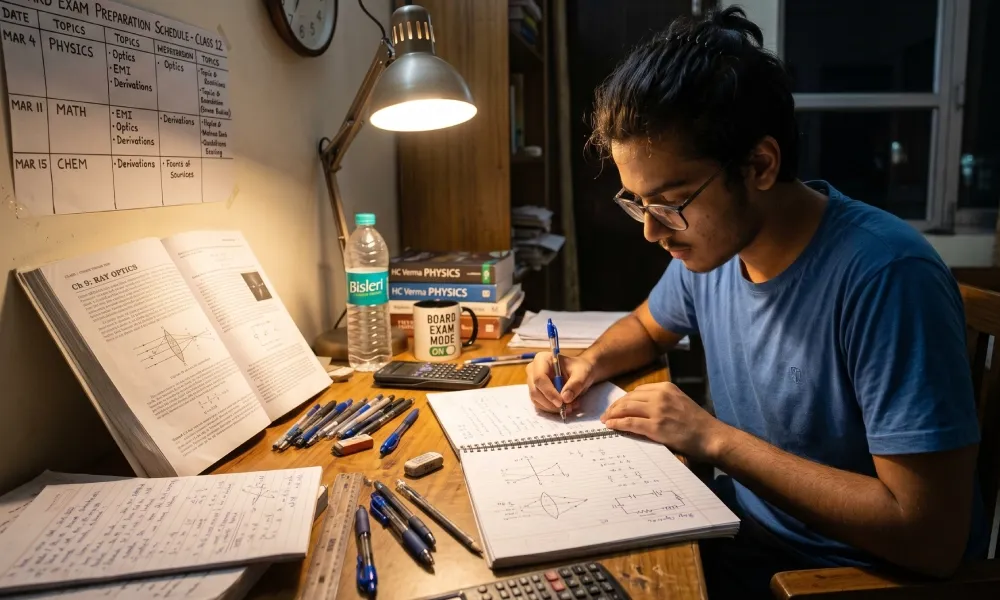
For students, transitioning from Class 10 to Class 11 is arguably the most challenging academic leap. Why? Because in Class 10, student study the subject of science, which is largely descriptive, conceptual, and manageable through regular study. However, the moment one enters Class 11, then the subject of Physics transforms from simple definitions into an intricate ecosystem of vector mathematics, calculus driven derivations, and multi layered problem solving.
If you are aiming to secure admission into premium engineering or medical seats, then Class 11 is where the foundation for competitive exams is laid. Your goal is to gain admission to the Indian Institutes of Technology (IITs) or securing a Top Government Medical College. How you will handle this foundational year determines your path.
If you are a student or a parent searching for the right guidance, finding the best physics classes in Indore for class 11 can provide the necessary competitive edge. Let’s break down the definitive blueprint for mastering Class 11 Physics.
The biggest trap for a Class 11 student is relying on the study habits that brought them success in school. In school exams, you could memorize a derivation, state a law, plug numbers into a direct formula, and score a perfect 100%. But in competitive environments, that approach fails instantly.
Physics describes how the universe behaves. For example, if you are studying Mechanics, then you must visualize the forces at play like when a block slides down an inclined plane, then you shouldn't just copy the Free Body Diagram (FBD), you need to understand why gravity splits into sine and cosine components based on the geometry of the angle.
Before you touch the actual physics chapters like Kinematics or Laws of Motion, then you must master the mathematical tools. The first two weeks of any elite physics coaching is dedicated entirely to Mathematical Tools: Vectors, Basic Differentiation, and Integration. If your calculus is weak, then your physics will inevitably crumble by the time you reach Work, Energy, and Power. So, treat mathematics as the language of Physics.
Class 11 Physics can be broadly divided into four core blocks that requires a distinct mental approach and varying levels of problem-solving rigor depending on whether you are preparing for JEE or NEET.
| Physics Block | Primary Focus Areas | Core Strategy |
|---|---|---|
| Mechanics | Kinematics, Laws of Motion, Rotational Dynamics, Gravitation | Master Free Body Diagrams (FBDs); focus on variable constraints rather than fixed formulas. |
| Properties of Matter | Elasticity, Fluid Mechanics, Surface Tension, Viscosity | Understand microscopic behaviours; memorize specific dimensional relationships and boundary conditions. |
| Thermodynamics | Kinetic Theory of Gases, Laws of Thermodynamics, Heat Transfer | Focus on sign conventions; correlate PV-diagrams with mathematical equations. |
| Waves & SHM | Simple Harmonic Motion, Wave Propagation, Sound Waves, Doppler Effect | Master trigonometric equations, phase changes, and vector superposition principles. |
While the core concepts of Class 11 Physics remain unchanged, the application strategies taught in specialized physics classes for JEE are different from those in the physics classes for neet.
JEE Physics involves deep mathematical application and multi-concept synthesis. For example, a single problem might require you to apply the conservation of linear momentum, calculate a rotational moment of inertia, and then utilize simple harmonic motion equations to find a time period.
The strategy you will apply - You must prioritize derivation tracking by understanding a formula that comes from altering the boundary conditions. For example, you can make gravity variable instead of a constant, and then you can derive a custom solution on the spot.
NEET Physics is a race against time, where you have to solve 45 questions in a highly restricted time frame. This means that your speed, pattern recognition, and calculation must be accurate.
The Strategy you will apply - You must focus heavily on NCERT text and direct-application numerical. In JEE, you can focus on deep conceptual manipulation, while in NEET you can recall formulas and rapid approximation techniques.
Data from major coaching hubs indicates that over 65% of students accumulate a critical academic backlog by October of Class 11, typically triggered by the complexity of Rotational Motion. The other facts include
Syllabus Overlap - There are roughly 40% to 45% of all questions asked in JEE and NEET competitive exams which are derived directly from Class 11 topics, and makes it impossible to clear these exams by only studying the Class 12 syllabus.
The Mechanics Weightage - This includes constitutes nearly 20% of the entire physics paper in competitive entrance examinations.
When students are presented with a complex numerical, then untrained ones immediately look for a formula to plug numbers into. If the formula isn't obvious, then they get stuck. Toppers use such a structured, three-step execution pattern:
Isolate the System and Draw - Here, they read the question line by line and translate the text into a visual representation. If you can identify the system, then draw all acting forces (forces of tension, friction, normal reaction, and gravity).
Identify Safe Conservations - Ask yourself some questions such as what physical quantities remain constant during the interaction. Is mechanical energy conserved? Is momentum conserved? This limits your mathematical variables.
Execute and Sanity-Check - Set up your equations and solve. Once you have a numerical or dimensional answer, then do a sanity check. If you calculate the velocity of a standard block to be faster than the speed of light, then you know a mathematical error has occurred along the line.
As you begin your journey through Class 11, you must be fiercely protective of your schedule and avoid these silent killers of academic ranks:
Ignoring NCERT - Many students in physics classes for jee believe that NCERT is too basic. This is a massive mistake as theoretical conceptual points and Points to Ponder sections in NCERT form the basis for direct conceptual questions.
Collecting Too Many Books - Do not buy five different reference books. Stick to your coaching modules, which is a standard conceptual book (like H.C. Verma), and past year's question banks (PYQs). Yu need to master one high-quality book three times, which is infinitely better than skimming five books once.
Hiding Your Doubts - A single unaddressed doubt in Vectors will haunt you all the way through Electrodynamics in Class 12. So, clear your doubts within 48 hours of learning a concept.
The Path Forward
Class 11 Physics is undeniably demanding, but it is also one of the most rewarding subjects that you will ever study. It changes how you look at the physical world around you. Success does not require extraordinary genius, it requires consistency, structured practice, and the right guidance to break down intimidating theories into bite sized components.
If you want to convert conceptual confusion into academic clarity, then choose the right environment. Win Physics is widely recognized as a premier destination for physics classes for class 11 in Indore. Here, the physics classes for NEET and advanced problem-solving tracks in physics classes for JEE will help you eliminate exam fear, and foster a genuine love for problem solving. So, begin your journey to exam mastery today.