Office Hours:
Mon - Sat : 10:00 AM to 7:00 PM
For Queries Call:
+91 94064 18754
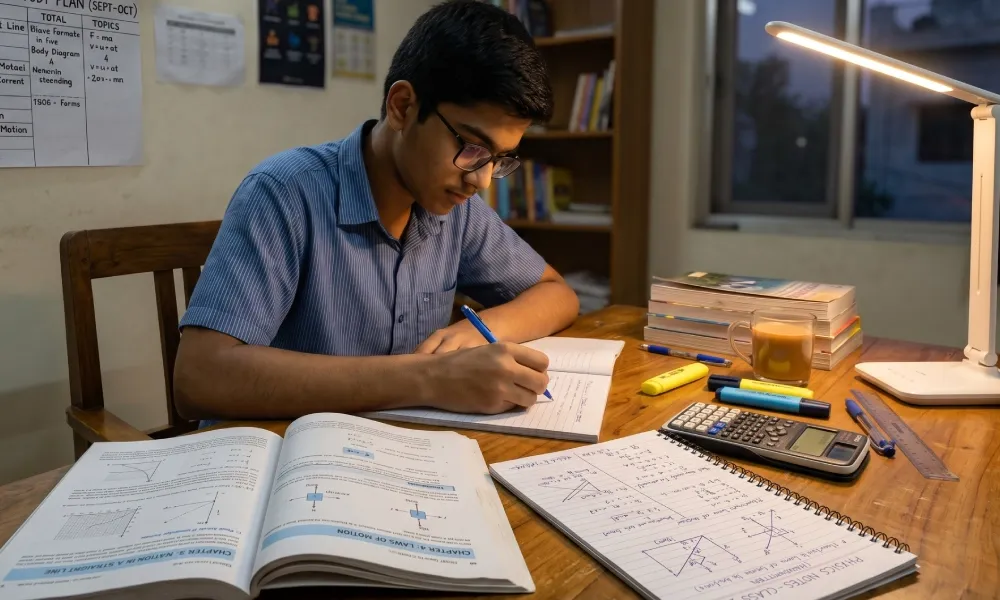
Preparing for your Class 12 Physics board exam can feel like a stressful balancing act. However, if you are already taking physics classes for JEE or NEET, then you are probably used to solving multiple choice questions in seconds. You might use mental shortcuts or tricks to find the right option fast. But the board exams are completely different where Board examiners do not just care about the final answer. They want to see how you got there.
Therefore, to score above 95% in your board exams without hurting your competitive prep, you need to learn how to present your answers clearly on paper.
The Class 12 Physics syllabus is very logical unlike Class 11, which is all about moving blocks and pulleys. In Class 12, students have to deal with things that you cannot see, like electric fields, light waves, and atoms. In this, you can divide the syllabus into following three main blocks:
This is the biggest chunk of your paper, which includes chapters like Electrostatics, Current Electricity, Magnetism, and Alternating Current (AC).
The trick for boards is to memorize standard derivations step-by-step. For example, deriving the electric field of a dipole or using Ampere’s Law are favourite questions for examiners.
The competitive link block requires strong vector skills, which will help you greatly in your physics classes for jee.
Optics is highly visual and carries a lot of weight.
The Trick for Boards is to practice your ray diagrams with a ruler. The Lens Maker’s Formula and telescope diagrams are frequently asked as long 5-mark questions. For Wave Optics, you need to make sure that you can derive the fringe width formula for Young's Double Slit Experiment.
This is the easiest and highest-scoring part of the book, which covers Atoms, Nuclei, Dual Nature of Matter, and Semiconductors.
The Trick for Boards is that the questions here are direct and theoretical. In this, the focus on simple explanations, like how a solar cell works or what happens in a p-n junction diode.
The Competitive Link has the chapters that are mostly formula-based, and help medical aspirants in physics classes for NEET score quick points under time pressure.
In a JEE or NEET mock test, a tiny calculation error at the very end means that you will lose marks. But in a board exam, if your method is correct, then your final calculation goes wrong, and you still get most of the marks. This is because boards use Step-Marking method. Therefore, to get maximum marks, you need to write your answers using this simple four-step structure
First read the question and list the values given like Charge $q = 2\ \mu\text{C}$). Then convert all the units into standard SI units (like converting centimetres to meters) right away.
Secondly, write down the main formula that you are going to use on a fresh line before putting numbers into it.
Thirdly, show at least one or two lines of simple math, and never jump straight from the question to the answer.
Put a box around your final number and always write its unit like Volt, Tesla, or Joule). Just leave out the unit can cost you half a mark.
Around 70% of the marks in board exams come from derivations, definitions, and conceptual case studies. And only 30% are pure numerical problems. This is the exact opposite of JEE or NEET.
Almost all long 5-mark questions come from just four chapters, Ray Optics, Wave Optics, Magnetism, and Electromagnetic Induction. So, clear out these first.
New board patterns dedicate about 20% of the paper to competency-based case studies, where you read a passage and answer related questions.
The Step-Wise Marking Strategy for Theory
A massive piece of new information board aspirants is the strict enforcement of standard marking schemes meant for theoretical answers. When an examiner evaluates a definition or a case study response, they look for specific technical keywords listed in their official answer key. So, by simply writing a paragraph in your own words will not fetch full marks. To secure maximum points, you must state the core definition precisely as given in the NCERT, underline the critical physical terms, and write out any related conceptual conditions or limitations immediately below it. In board exams, your presentation style is just as vital as your knowledge.
A messy diagram tells the examiner that you don't know the concept well.
Always use a pencil and never freehand a circuit or a lens diagram with a pen. Only use a sharp pencil and a scale.
Draw the arrows in Ray Optics. Have a light ray without an arrow that shows where it is going is completely wrong. You will lose marks instantly.
Learn Core Graphs and practice standard graphs, like how photoelectric current changes with voltage or how resistance changes with temperature.
A critical change in recent board evaluation is the strict penalty for unlabelled axes and missing slope declarations. The examiners are now instructed to deduct a flat half mark for any graph that lacks explicit physical quantities and their respective SI units on both the x and y axes. Furthermore, when you are plotting curves like the photoelectric current versus potential or the variation of resonant frequency, then you must clearly indicate the vital intercept points or threshold values. By simply drawing the shape of a curve, then it is not enough, you need to explicitly show the physical meaning of its slope or intercept to secure full credit.
The Board papers are made directly from the NCERT textbook. So, solve the blue in-text questions and the back exercises at least twice.
Board exams repeat questions very often, so if you solve the last 7 years of actual board papers, then you will see the exact same patterns show up on your exam day.
Don't get stuck on a difficult 2 marks question for twenty minutes. Just move on and secure your long 5-mark answers first.
You Can Do Both
You do not need to stop your JEE or NEET preparation to do well in your boards. When you study a formula in your entrance coaching, just practice writing out its derivation on a piece of paper once or twice. By learning how the formula is made, you will build deep concepts for your competitive exams while automatically preparing for your boards.
Are you finding it difficult to manage school board writing while keeping up with your competitive syllabus? Win Physics will make it easy for you. The syllabus is designed to handle both the worlds smoothly.
You will learn the deep problem-solving tricks needed for your physics classes for Class 12, JEE and the high-speed patterns, while showing you exactly how to write answers to ace your board exams.
Just learn how to balance your preparation and secure your dream scores with us. Master your Class 12 Physics journey with Win Physics.